
James Van AllenBirth Chart
James Alfred Van Allen
07/09/1914 unknown time
AX - No time - documented source
Mount Pleasant (IA)
USA
40°58' ↑ North - 91°33' ← West
06:00 West
Sun Moon

Photo: Reproduction
James Alfred Van Allen was an American space physicist whose career at the University of Iowa was decisive for the development of magnetospheric research. He became internationally known in 1958 for discovering the radiation belts that now bear his name: two zones of charged particles trapped by Earth’s magnetic field, a discovery that was the first major scientific finding of the Space Age. As principal investigator for scientific instruments on two dozen satellites and planetary missions, Van Allen made the first in situ measurements of the magnetospheres of Jupiter and Saturn, detected rings and moons by their particle-absorption signatures, and maintained decades-long cosmic-ray observations that mapped its radial gradient across the heliosphere. He led pioneering programs of sounding rockets and Rockoons and played a central scientific role during the International Geophysical Year (1957–58). Recognized by the scientific community, he was elected to academies and awarded honors such as the National Medal of Science and the Crafoord Prize. A proponent of unmanned planetary exploration, Van Allen also influenced the planning of the Pioneer missions and established instrumental and conceptual foundations that shaped spacecraft design and protection against the Earth’s radiation environment.
Read more about James Van Allen on Wikipedia
Share
Text mode
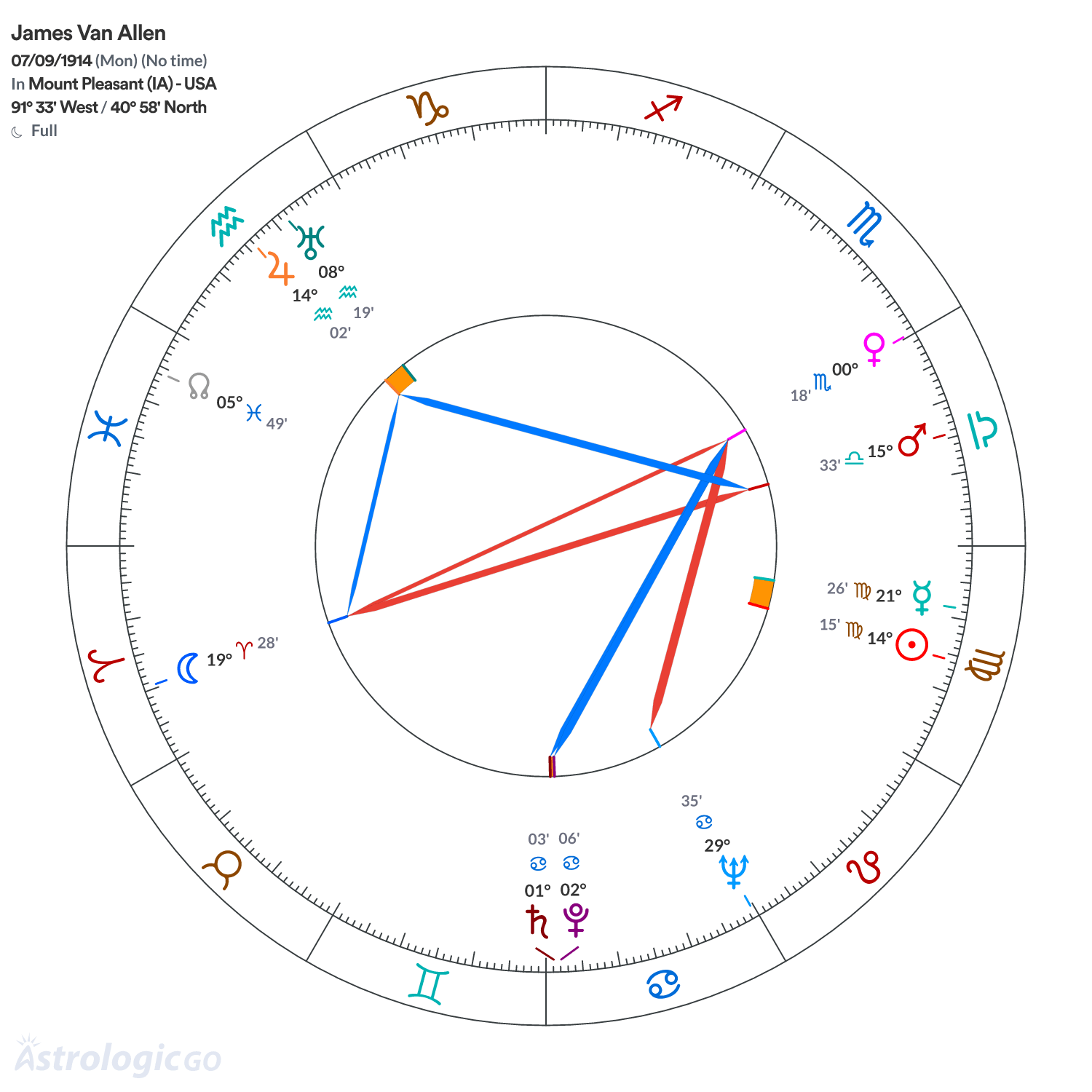
↣ Sun in Virgo - 14°15'
↣ Moon in Aries - 19°29'
↣ Mercury in Virgo - 21°26'
↣ Venus in Scorpio - 00°18'
↣ Mars in Libra - 15°33'
↣ Jupiter in Aquarius - 14°02' - retrograde
↣ Saturn in Cancer - 01°04'
↣ Uranus in Aquarius - 08°20' - retrograde
↣ Neptune in Cancer - 29°36'
↣ Pluto in Cancer - 02°07'
↣ North Node in Pisces - 05°50' - retrograde
↣ Sun and Mercury conjunction (7°11' separating)
↣ Sun and Mars antiparallel
↣ Sun and North Node opposition (8°25' separating)
↣ Moon and Venus opposition (10°49' applying)
↣ Moon and Mars opposition (3°56' separating)
↣ Moon and Jupiter sextile (5°27' separating)
↣ Venus and Saturn trine (0°45' applying)
↣ Venus and Neptune square (0°42' separating)
↣ Venus and Pluto trine (1°48' applying)
↣ Venus and North Node trine (5°32' applying)
↣ Mars and Jupiter trine (1°31' separating)
↣ Jupiter and Uranus conjunction (5°43' applying)
↣ Jupiter and Pluto antiparallel
↣ Saturn and Pluto conjunction (1°03' applying)
↣ Saturn and North Node trine (4°46' applying)
↣ Uranus and Pluto antiparallel
↣ Pluto and North Node trine (3°44' applying)