
George Paget ThomsonBirth Chart
03/05/1892 unknown time
XX - Time not informed
Cambridge
England
52°13' ↑ North - 0°08' → East
00:00
Sun Moon

Photo: Reproduction
George Paget Thomson was an English experimental physicist recognized for demonstrating the wave properties of electrons. His electron diffraction experiments on metal films provided quantitative verification of de Broglie’s hypothesis and made a decisive contribution to establishing wave–particle duality in quantum mechanics. For this work, he shared the 1937 Nobel Prize in Physics with Clinton Davisson.
During his academic career he held chairs at Aberdeen and Imperial College London, and lectured as a non-resident lecturer at Cornell. In the 1930s and 1940s he shifted his research toward nuclear physics and its practical applications, playing a prominent role as chair of the MAUD Committee, which assessed the feasibility of a nuclear device in the context of World War II.
He later continued to write on aerodynamics and the role of science in society, and served as Master of Corpus Christi College, Cambridge (1952–1962). His legacy combines fundamental experimental contributions to quantum physics with engagement in debates and projects that linked science and public policy in the 20th century.
Read more about George Paget Thomson on Wikipedia
Share
Text mode
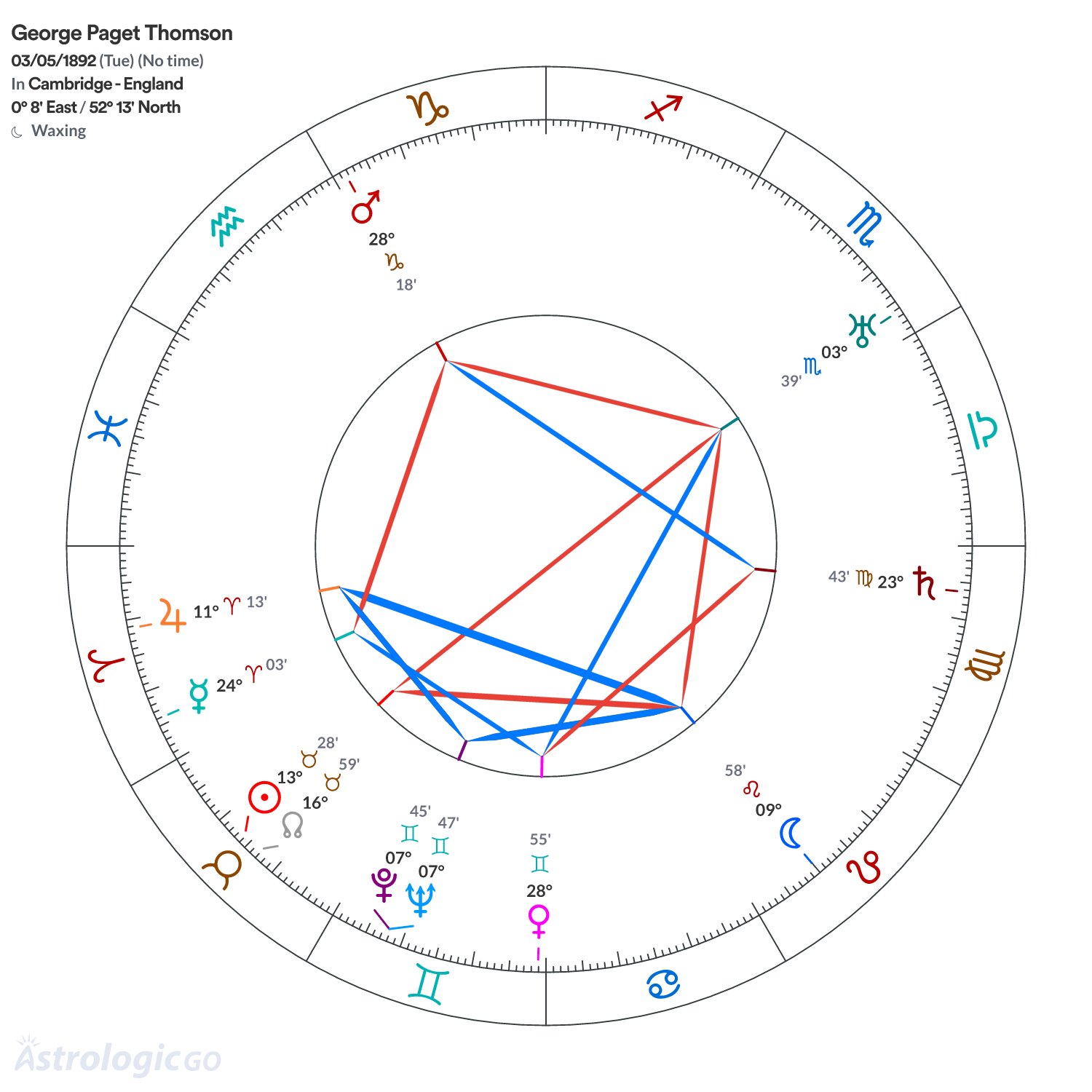
↣ Sun in Taurus - 13°29'
↣ Moon in Leo - 09°58'
↣ Mercury in Aries - 24°03'
↣ Venus in Gemini - 28°55'
↣ Mars in Capricorn - 28°19'
↣ Jupiter in Aries - 11°14'
↣ Saturn in Virgo - 23°44' - retrograde
↣ Uranus in Scorpio - 03°39' - retrograde
↣ Neptune in Gemini - 07°47'
↣ Pluto in Gemini - 07°45'
↣ North Node in Taurus - 16°59'
↣ Sun and Moon square (3°31' applying)
↣ Sun and Uranus opposition (9°50' separating)
↣ Sun and North Node conjunction (3°30' applying) parallel
↣ Moon and Mars antiparallel
↣ Moon and Jupiter trine (1°16' applying)
↣ Moon and Uranus square (6°19' separating)
↣ Moon and Neptune sextile (2°10' separating)
↣ Moon and Pluto sextile (2°13' separating)
↣ Mercury and Venus sextile (4°52' separating)
↣ Mercury and Mars square (4°15' separating)
↣ Venus and Saturn square (5°11' separating)
↣ Venus and Uranus trine (4°44' applying)
↣ Mars and Saturn trine (4°35' separating)
↣ Mars and Uranus square (5°20' applying)
↣ Jupiter and Neptune sextile (3°26' separating)
↣ Jupiter and Pluto sextile (3°29' separating)
↣ Neptune and Pluto conjunction (0°02' separating)