
J. J. ThomsonBirth Chart
Joseph John Thomson
18/12/1856 unknown time
XX - Time not informed
Manchester
England
53°30' ↑ North - 2°15' ← West
00:00
Sun Moon

Photo: Reproduction
Sir Joseph John Thomson was a British physicist whose research transformed the understanding of atomic structure in the late 19th and early 20th centuries. He is chiefly remembered for the discovery of the electron in 1897, when he showed that cathode rays consisted of negatively charged particles far lighter than atoms, measured their charge-to-mass ratio, and demonstrated that atoms were divisible. This finding opened the way for particle physics and for the development of instrumental techniques, including the earliest applications of mass spectrometry to the study of positive ions. Thomson also proposed, in 1904, an atomic model (known as the "plum pudding" model) that sought to explain the electrical neutrality of atoms and sparked debates that led to later models. In 1906 he received the Nobel Prize in Physics for investigations on the conduction of electricity in gases. His scientific output includes works on electromagnetism, dynamics, and transformations of energy, which served as references and teaching texts of the period. As a professor and laboratory director, he exerted decisive influence on generations of researchers: many of his students and collaborators became Nobel laureates, reinforcing his reputation as a trainer of talent. He was honored with a knighthood and the Order of Merit; his legacy endures in the experimental and conceptual foundations of atomic physics.
Read more about J. J. Thomson on Wikipedia
Share
Text mode
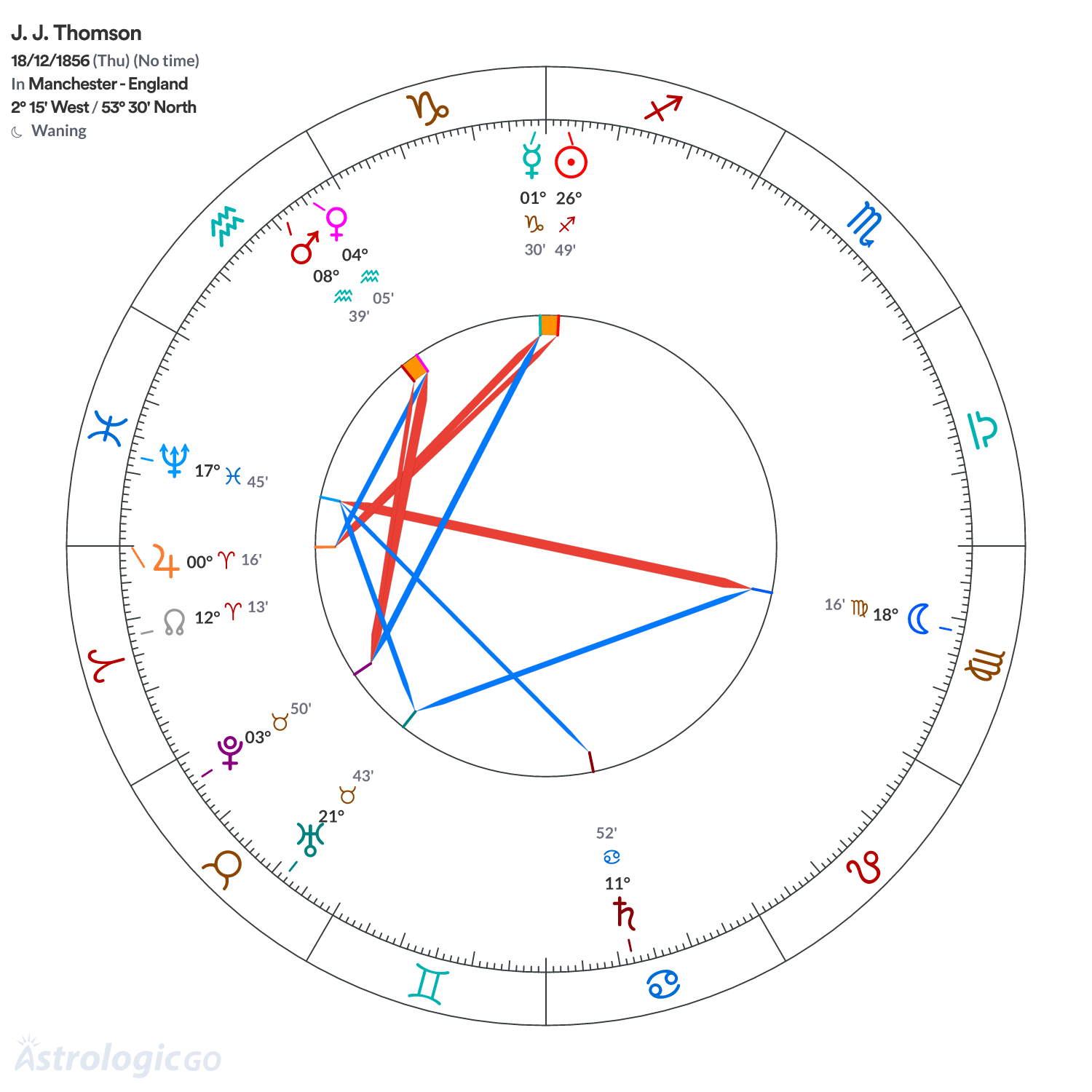
↣ Sun in Sagittarius - 26°50'
↣ Moon in Virgo - 18°17'
↣ Mercury in Capricorn - 01°31'
↣ Venus in Aquarius - 04°05'
↣ Mars in Aquarius - 08°40'
↣ Jupiter in Aries - 00°16'
↣ Saturn in Cancer - 11°52' - retrograde
↣ Uranus in Taurus - 21°43' - retrograde
↣ Neptune in Pisces - 17°46'
↣ Pluto in Taurus - 03°50' - retrograde
↣ North Node in Aries - 12°13' - retrograde
↣ Sun and Mercury conjunction (4°40' separating)
↣ Sun and Jupiter square (3°26' applying)
↣ Sun and Saturn antiparallel
↣ Moon and Uranus trine (3°26' applying)
↣ Moon and Neptune opposition (0°31' separating) antiparallel
↣ Mercury and Jupiter square (1°14' separating)
↣ Mercury and Pluto trine (2°20' applying)
↣ Venus and Mars conjunction (4°34' applying)
↣ Venus and Jupiter sextile (3°50' separating)
↣ Venus and Pluto square (0°15' separating)
↣ Mars and Pluto square (4°49' separating)
↣ Mars and North Node sextile (3°34' applying)
↣ Saturn and Neptune trine (5°53' separating)
↣ Saturn and North Node square (0°21' separating)
↣ Uranus and Neptune sextile (3°57' applying)