
John HerschelBirth Chart
John Frederick William Herschel
07/03/1792 unknown time
XX - Time not informed
Slough
England
51°31' ↑ North - 0°36' ← West
00:02 West
Sun Moon or

Photo: Reproduction
John Frederick William Herschel was an English polymath whose work spanned mathematics, astronomy, chemistry and experimental photography. The son of the astronomer William Herschel, he established himself as an observer and organizer: he compiled and expanded catalogues of nebulae and double stars, publishing in 1864 the General Catalogue of Nebulae and Clusters, a work that brought together his and his father’s observations. He was also a founder of the Royal Astronomical Society and served as its president three times, being awarded the Society’s Gold Medal and the Royal Society’s Copley Medal.
Herschel made important practical and instrumental contributions—he built large reflecting telescopes to survey the sky and adopted the use of the Julian day system in astronomy—and he identified moons and satellites of Saturn and Uranus. In 1834 he settled at the Cape of Good Hope to catalogue the southern sky, a period in which he produced notable observations and collaborated with local astronomers.
Beyond astronomy, he worked on photographic chemistry—he is remembered for inventing the process that led to the blueprint—and wrote A Preliminary Discourse on the Study of Natural Philosophy (1831), a defense of inductive inquiry that influenced generations of scientists. His legacy combines observational achievements, technical advances and conceptual influence on scientific methodology.
Read more about John Herschel on Wikipedia
Share
Text mode
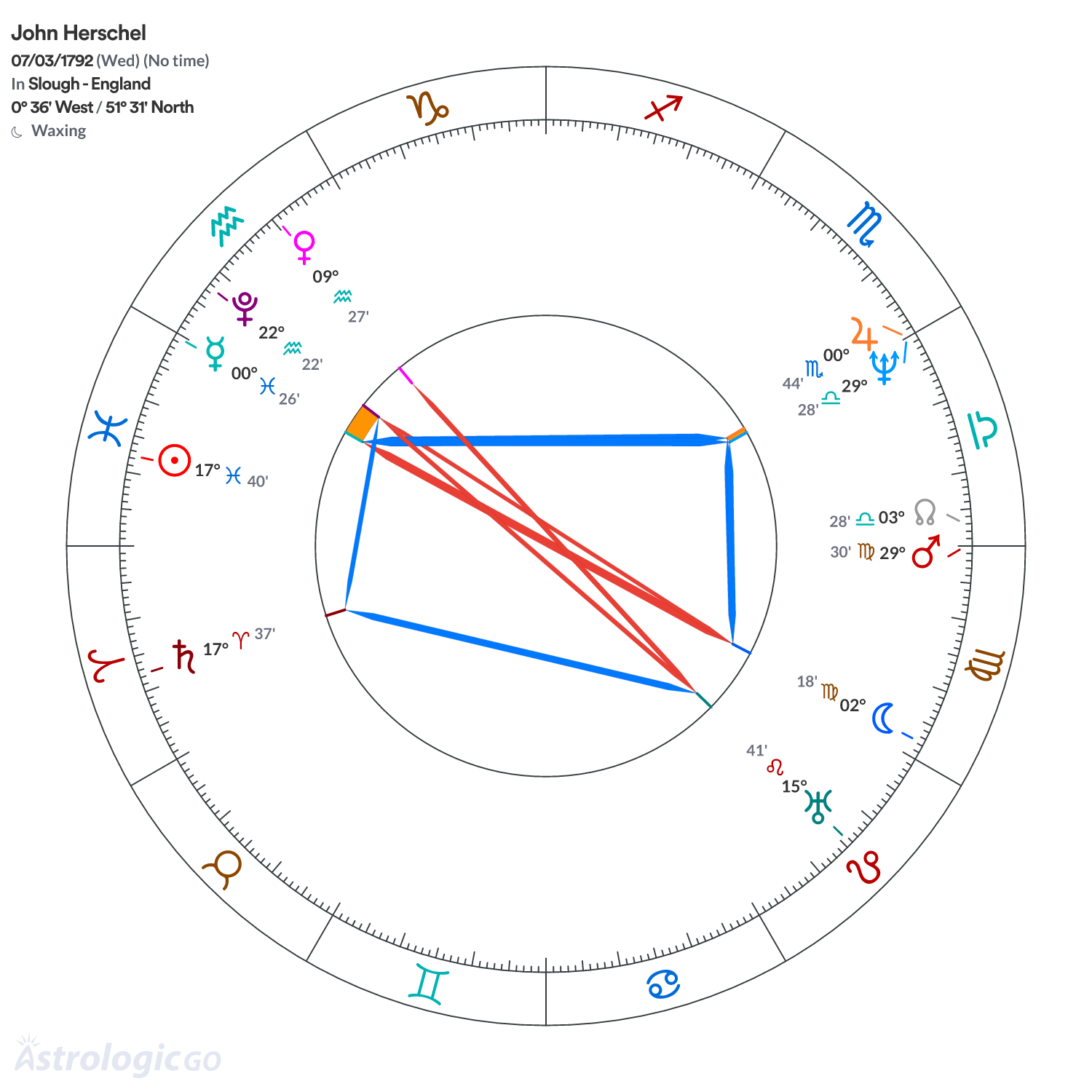
↣ Sun in Pisces - 17°40'
↣ Moon in Virgo - 02°19'
↣ Mercury in Pisces - 00°27'
↣ Venus in Aquarius - 09°28'
↣ Mars in Virgo - 29°30' - retrograde
↣ Jupiter in Scorpio - 00°44' - retrograde
↣ Saturn in Aries - 17°37'
↣ Uranus in Leo - 15°42' - retrograde
↣ Neptune in Libra - 29°29' - retrograde
↣ Pluto in Aquarius - 22°22'
↣ North Node in Libra - 03°29' - retrograde
↣ Sun and Mars antiparallel
↣ Sun and Saturn antiparallel
↣ Moon and Mercury opposition (1°51' separating)
↣ Moon and Jupiter sextile (1°34' separating)
↣ Moon and Neptune sextile (2°50' separating)
↣ Moon and Pluto opposition (9°56' separating)
↣ Mercury and Jupiter trine (0°17' applying)
↣ Mercury and Neptune trine (0°58' separating)
↣ Mercury and Pluto conjunction (8°05' separating)
↣ Venus and Uranus opposition (6°14' applying) antiparallel
↣ Venus and North Node trine (5°59' separating)
↣ Mars and North Node conjunction (3°58' separating)
↣ Jupiter and Neptune conjunction (1°16' applying) parallel
↣ Saturn and Uranus trine (1°56' separating)
↣ Saturn and Pluto sextile (4°45' applying)
↣ Uranus and Pluto opposition (6°40' separating)